
NetSuite Next: Unpacking the 'AI Your Way' Strategy for Autonomous ERP
As Evan Goldberg, founder and executive vice president, Oracle NetSuite, stated, "NetSuite Next puts AI to work for businesses by making it a natural extension of the way they already work. With the latest AI innovations built in, NetSuite Next can deliver powerful insights as well as autonomously complete repetitive and complex tasks, all with enterprise-level reliability."
Is NetSuite's 'AI Your Way' just marketing hype, or a real step towards systems that can run themselves, making your business smarter and more efficient? That's the big question for IT leaders, ERP managers, business analysts, and developers. I've looked closely at the latest news, technical guides, and market reports to give you the true story behind NetSuite Next.
NetSuite Next: What They Say vs. What It Really Is
Honestly, NetSuite's 'AI Your Way' plan, built around the NetSuite Next platform, is a big change. It's all about using AI that's flexible, acts on its own, and explains its decisions within your ERP system. The official word is that it's an AI engine for medium to large companies, promising a future where operations run themselves. But what does that truly mean for your daily work? And is your company actually ready to use this power?
Table of Contents
- NetSuite Next: The Official Pitch vs. Reality
- Performance & "Real World" Benchmarks: Diving into NetSuite Next's AI Capabilities
- My Final Verdict: Is NetSuite Next the Right Move for Your ERP?
- Quick Overview: NetSuite Next's Vision for AI-First ERP
- Technical Deep Dive: SuiteCloud's Open, Composable AI Framework
- Navigating Adoption: Challenges and the Human-in-the-Loop Approach
Watch the Video Summary
Performance & "Real World" Benchmarks: Diving into NetSuite Next's AI Capabilities
When we talk about AI in ERP, the numbers really matter. It's not just about cool features; it's about real improvements to your profits and how fast you get things done. My look at NetSuite Next shows it's entering a fast-growing market, with huge expected growth and clear benefits for those who use it smartly.
| Metric | Current State / Projection | Impact on Business |
|---|---|---|
| AI-in-ERP Market Growth (2025-2035) | $5.8 Billion to $58 Billion (10x increase) | Signals massive industry shift and investment in AI-driven ERP solutions. |
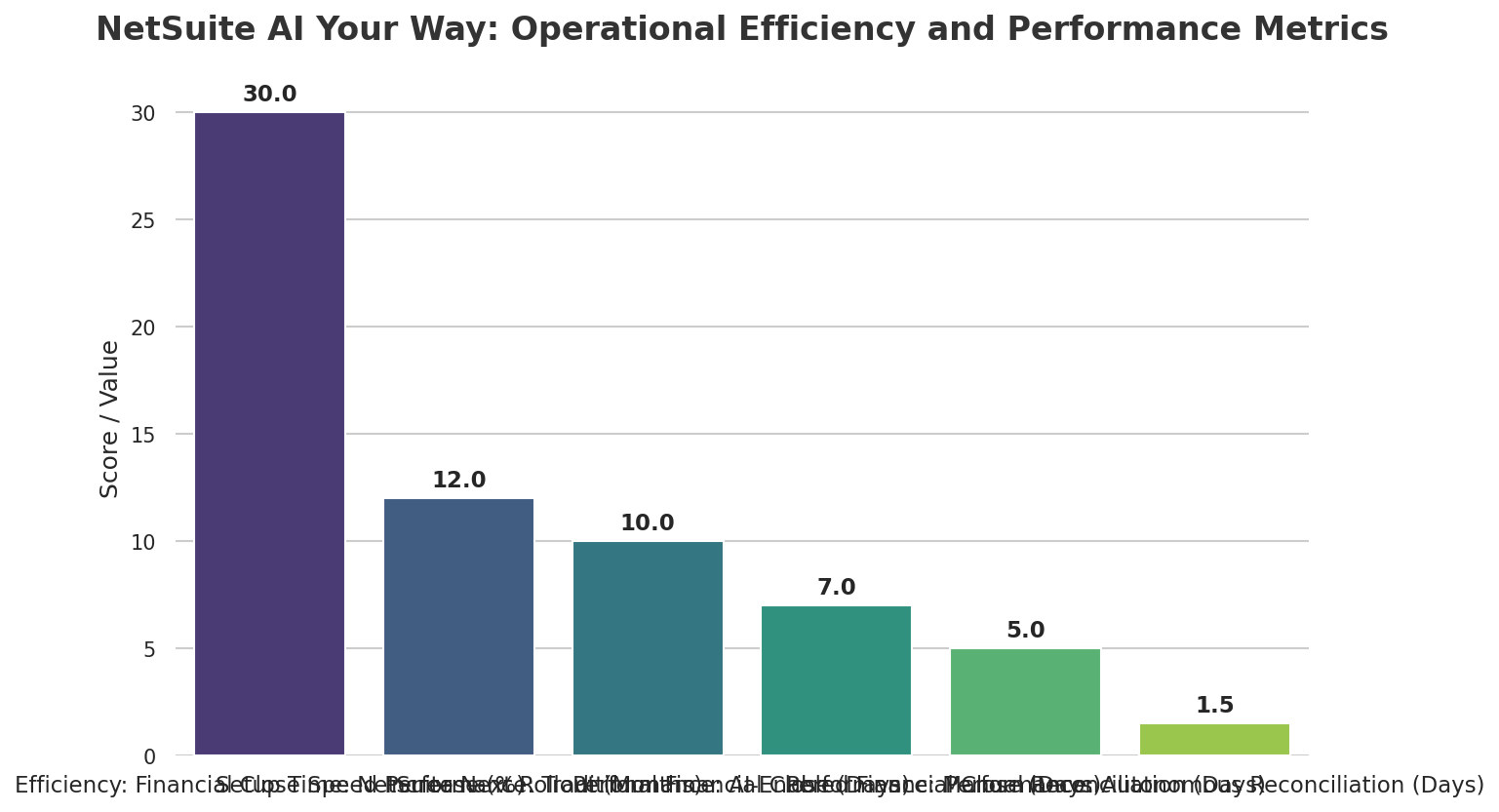
| Financial Close Speed Improvement (Gartner) | 30% faster by 2028 | Enables quicker decision-making and competitive advantage. |
| Manufacturers AI Readiness | Only 20% truly ready (98% exploring) | Highlights a significant gap and opportunity for early adopters to gain an edge. |
These numbers aren't just ideas; they show a big change in how businesses will work. For example, closing your books 30% faster means a company that usually takes 10 days could finish in 7 days (Gartner, Feb 2026). That's a huge advantage for being quick and responsive.
My Final Verdict: Is NetSuite Next the Right Move for Your ERP?
NetSuite Next's 'AI Your Way' plan, with its focus on flexible, self-acting, and explainable AI, makes Oracle's ERP platform a strong base for AI. It brings big improvements in business insights and automation. If your company is ready to fix basic issues like data quality and how your processes are set up, then NetSuite Next offers a clear path to more self-running and efficient operations.
For those who are unsure about full automation, NetSuite's approach of keeping humans in the loop provides a comforting middle ground. If you're already using NetSuite a lot and want to use advanced AI without replacing your whole ERP system, then NetSuite Next is a definite recommendation.
However, if you're not currently using NetSuite and are looking at AI-first solutions, you'll need to compare the benefits with the possible costs and learning curve of switching. For companies that prefer to adopt AI slowly and build trust, NetSuite's focus on explaining AI decisions and human oversight makes it a strong choice.
Quick Overview: NetSuite Next's Vision for AI-First ERP
Here's the deal: NetSuite Next, first shown at SuiteWorld 2025 (Futurum Research, Oct 2025), isn't just another update. It's a big change towards an ERP system where AI comes first. My take? This is NetSuite saying, "We're not just adding AI; we're rebuilding everything around it."
The main ideas here are AI that you can talk to, AI that explains itself, and AI that acts on its own. Think of it this way: instead of clicking through endless menus, you can simply ask your ERP system a question, just like you would a smart assistant. That's where Ask Oracle comes in – a natural language helper designed to let you search, move around, analyze, and act across your NetSuite and partner apps (Futurum Research, Oct 2025). It's all about making your business insights easier to get and use, moving past simple reports to dynamic, interactive information.
Technical Deep Dive: SuiteCloud's Open, Composable AI Framework
Under the Hood: The SuiteCloud AI Ecosystem
The NetSuite AI Connector Service acts as a secure, protocol-driven bridge (supporting Model Context Protocol - MCP) that allows NetSuite to integrate with external AI platforms like Claude or ChatGPT. It enables AI agents to access and interact with NetSuite data and functionality using natural language, while enforcing granular control, authentication, and role-based access aligned with NetSuite's security model. This facilitates "bring-your-own-AI" flexibility and streamlines complex AI-ERP integrations into reusable SuiteApps.
For the developers and tech lovers out there, this is where things get really interesting. NetSuite's AI plan isn't a mystery box; it's built on an open, flexible system within SuiteCloud. This means you, the developer, have the tools to expand and change NetSuite's AI features to fit your specific business needs.
The SuiteCloud improvements are strong, including the AI Connector Service (for safely linking outside AI models), SuiteAgents Frameworks (for building your own AI agents right inside NetSuite), AI Toolkits & Assistants (showing how AI thinks and creates summaries through APIs), and AI Studios (for managing AI prompts and results with care) (Futurum Research, Oct 2025). This clearly shows that NetSuite is giving power to its community, not just offering ready-made solutions.
The market for AI in ERP is growing fast, expected to hit $58 billion by 2035, up from $5.8 billion in 2025. This growth is happening because of platforms like SuiteCloud that help developers create new things. For SuiteScript 2.1 developers, the new N/llm Module is a significant advancement. It lets you add large language model features directly into your custom code. Here's a quick look at what that could be like:
/**
 * @NApiVersion 2.1
 * @NScriptType UserEventScript
 */
define(['N/record', 'N/search', 'N/llm'], (record, search, llm) => {

    const afterSubmit = (context) => {
        if (context.type === context.UserEventType.CREATE || context.type === context.UserEventType.EDIT) {
            const newRecord = context.newRecord;
            const customerName = newRecord.getValue('entityid');
            const salesOrderAmount = newRecord.getValue('total');

            try {
                // Example: Use N/llm to generate a summary for a new sales order
                const prompt = `Generate a concise summary for a new sales order for customer \"${customerName}\" with a total amount of $${salesOrderAmount}. Highlight key details.`;
                const llmResponse = llm.generateText({
                    model: 'oracle-llm-service', // Placeholder for a hypothetical Oracle LLM service
                    prompt: prompt,
                    maxTokens: 100
                });

                const summary = llmResponse.choices[0].text;
                log.debug('AI Generated Sales Order Summary', summary);

                // Optionally, update a custom field with the summary
                record.submitFields({
                    type: newRecord.type,
                    id: newRecord.id,
                    values: {
                        custbody_ai_summary: summary // Assuming a custom field exists
                    },
                    options: {
                        enableSourcing: false,
                        ignoreMandatoryFields: true
                    }
                });

            } catch (e) {
                log.error('Error generating AI summary for sales order', e.message);
            }
        }
    };

    return {
        afterSubmit: afterSubmit
    };
});
This code shows how you could use the N/llm module to automatically create a summary for a sales order, putting AI right into your business tasks. This is powerful stuff, allowing for truly smart automation.
Real-World Impact: Agentic Workflows & Explainable Insights
So, what does all this technical magic mean for your daily work? It means features that automate hard tasks and give you useful information. Think of Ask Oracle not just as a search bar, but as a smart helper that understands your data and shows you pictures to back up its answers (Futurum Research, Oct 2025). This is about getting real insights, not just bits of data.
For instance, industry observations and reports from early adopters indicate that leveraging NetSuite Bill Capture has led to significant reductions in manual data entry for vendor invoices. AI and OCR capabilities automatically populate bill records and match them to purchase orders, directly translating to faster invoice processing and fewer errors, thereby freeing up AP staff for more strategic tasks.
Then there's AI Canvas, a visual space made for solving problems together and starting automated tasks. Imagine your team working side-by-side, with AI agents doing the heavy lifting. And for those boring reporting jobs, Narrative Insights automatically summarizes trends across your records and reports (Futurum Research, Oct 2025). This means you spend less time crunching numbers and more time acting on what they tell you.
The real magic comes from Agentic Workflows, which can automate tricky reconciliations and even help pick vendors. Gartner predicts that adding AI to cloud ERP can lead to a 30% faster financial close by 2028. This isn't just about speed; it's about freeing up your team to focus on important plans instead of manual, repeated tasks.
Enhanced Business Intelligence: Payments & Subscription Analytics
NetSuite isn't just adding AI on top; it's putting it right into key business functions. Take payments, for example. A smart partnership with BILL brings intelligent payment automation directly into NetSuite. This covers US bank payments, AI-powered bill capture, matching, payment proposals, and reconciliation (Futurum Research, Oct 2025). This is a huge win for medium to large companies looking to make their financial operations smoother.
For businesses that rely on subscriptions, NetSuite Subscription Metrics now offers AI-improved views into key numbers like MRR/ARR growth, retention, CAC payback, and cohort analysis (Futurum Research, Oct 2025). And in the next year, expect AI-generated summaries to turn complex subscription data into easy-to-understand reports for your board. This means less time making reports and more time understanding what's driving your subscription business.
Navigating Adoption: Challenges and the Human-in-the-Loop Approach
Let's be real: bringing AI into your ERP system has its challenges. While 98% of manufacturers are looking into AI, only 20% feel truly ready. Common problems include bad data quality, old computer systems, how processes are designed, and making sure AI plans match company goals (ERP Insights). This gap between wanting to explore and being ready is where many companies struggle.
NetSuite tackles this directly with a strong focus on keeping humans involved in its automated tasks. This isn't about fully self-running systems going wild; it's about building trust and making sure there's oversight. My analysis shows that this method, combined with AI that explains itself (where you can easily check the data sources for AI-generated insights), is vital for companies to feel confident (Futurum Research, Oct 2025). It's about helping human intelligence, not replacing it entirely.
Competitive Edge: NetSuite's Position in the AI-ERP Landscape
In a busy market with companies like Epicor, Microsoft, and SAP quickly adopting generative AI, NetSuite needs to stand out. And it does. NetSuite's main differences include its AI that explains itself and understands different roles, which is deeply built into core tasks. It also has an open system for AI development that balances choices with rules, and strong support for partners through AI marketplaces and development tools (Futurum Research, Oct 2025). This open way of working encourages new ideas and makes the platform more appealing, meeting the market's need for AI that makes things easier while keeping control.
While some competitors focus on specific tools for certain industries, NetSuite is giving power to its users to create custom features quickly and safely. The SuiteApp.AI Marketplace and new AI badges (AI Elite and AI) offer trust signals for partner-made solutions, from built-in tax compliance (Avalara) to financial insights across different systems (Cauzzy) (Futurum Research, Oct 2025). This open approach encourages new ideas and makes the platform more appealing, meeting the market's need for AI that makes things easier while keeping control.
Practical Roadmap: Implementing 'AI Your Way' for Autonomous Operations
- Check & Clean Data: AI is only as good as your data. Start by checking your existing data for quality and making sure it's consistent. This basic step is a must-do.
- Try it on a Key Process: Don't try to automate everything at once. Find a task that's repeated, follows rules, and takes a lot of time (like matching invoices or choosing vendors) where AI can bring quick, clear value.
- Set Up Human Oversight Properly: Remember, NetSuite stresses human involvement. Design your AI tasks with clear points for human review and intervention. This builds trust and makes sure someone is responsible for AI decisions.
The importance of clear rules and responsibility for AI decisions cannot be overstated. Start small, learn quickly, and grow your use of AI strategically. NetSuite Next gives you the tools; how ready your company is will decide how fast and successfully you move towards an ERP system that runs itself.
Frequently Asked Questions
-
Is NetSuite's 'AI Your Way' truly customizable for unique business needs, or is it a set of predefined features?
NetSuite's 'AI Your Way' plan is built on an open, flexible system within SuiteCloud. It offers tools like the AI Connector Service and SuiteAgents Frameworks. This lets developers expand and customize AI features to fit unique business needs, going beyond just ready-made features.
-
How does NetSuite Next address concerns about data privacy and security when integrating external AI models via the AI Connector Service?
While the article highlights the AI Connector Service for safely connecting outside AI models, NetSuite's overall plan focuses on rules and keeping humans in the loop. This suggests built-in ways for secure data handling and oversight, though specific security steps for outside integrations would need more detailed technical information.
-
What are the initial steps an organization should take to prepare its data and processes for NetSuite Next's autonomous ERP capabilities?
Companies should start by checking and cleaning existing data to ensure quality and consistency. Next, try out AI on a key, repetitive process to show its value. Finally, design human-in-the-loop tasks with clear checkpoints for review to build trust and ensure accountability.
Sources & References
- NetSuite Boosts AI Adoption with SuiteWorld 2025 Announcements - Futurum
- NetSuite Applications Suite - NetSuite Features That Use AI
- AI Agents in ERP — When Systems No Longer Wait for Instructions and Can Execute End-to-End on Their Own | Enersys Insights
- AI in Business Intelligence 2025: Trends and Examples
- The Hidden Challenges of Bringing AI to NetSuite | Tim Dietrich
- AI in NetSuite 2026: The Complete Guide | GURUS Solutions
- NetSuite AI is a Game-Changer, But Not a Scriptwriter - StratusGreen
- What are the new AI Features in NetSuite? - Coefficient

Yousef S. | Latest AI
AI Automation Specialist & Tech EditorSpecializing in enterprise AI implementation and ROI analysis. With over 5 years of experience in deploying conversational AI, Yousef provides hands-on insights into what works in the real world.