Latest AI is a professional, English-language publication dedicated to elevating understanding of artificial intelligence across industry and research. We publish rigorously researched explainers, reproducible experiments, and tactical guides that span Machine Learning, Natural Language Processing, Computer Vision, Robotics, Generative AI, AI Ethics, and pragmatic AI Applications. Our mission is to close the gap between academic advances and production-ready deployment: we analyze SOTA research,
Google DeepMind's SynthID: Expanding to Text & Video – A Critical Analysis
Can an invisible watermark really tell us if something was made by AI? Or is Google DeepMind's SynthID just a small part of a much bigger, trickier problem? That's what I've been trying to figure out, and honestly, it's not a simple answer.
Google DeepMind's SynthID: The Official Pitch vs. Reality
Google DeepMind is really excited about its SynthID tool. They say it's a game-changer for spotting content made by AI. The really big news? SynthID can now work with text and video too! It started with images, and now it's growing. This isn't just a small change; it's a huge step to fight misinformation everywhere, whether it's in words or videos.
Initially launched for Imagen, it is now expanding to more Google models, such as Imagen 2 on Vertex AI and ImageFX, and is also being made available to third-party developers via Vertex AI.
Just recently, Google shared that SynthID can now add watermarks to AI-made text in their Gemini app and on the web. It also works for videos made with Veo, which is their best AI video tool. This move shows Google is serious about making AI responsibly, something we've talked about before when looking at how Veo 3.1 creates videos. But wait, there's more! If you're a developer or just love tinkering, you'll be thrilled to know they're planning to make SynthID open-source for text watermarking later this summer (DeepMind Blog). This means you'll soon be able to use this cool technology in your own creations.
The official story sounds great: an invisible watermark hidden right when the content is made, built to survive most changes people might make. But as I always say, you have to look closely at the details. While SynthID looks promising, it's not perfect and has its limits.
📸 how to prove your content's authenticity? embed invisible watermarks that persist through edits, compressions, and cropping.
Developer Perspectives on SynthID
For developers looking to integrate SynthID, Google has provided an open-source solution for text watermarking. However, it's important to note that this open-source version is not as robust as the one Google has deeply integrated into its own models.
So, how does this magic actually work? SynthID has a really smart way of doing things. For pictures and videos, it uses a special kind of AI called 'deep learning' to hide an invisible digital watermark right inside the content. The best part? This watermark doesn't mess with how the image or video looks, and it's added the moment the content is made (DeepMind Blog).
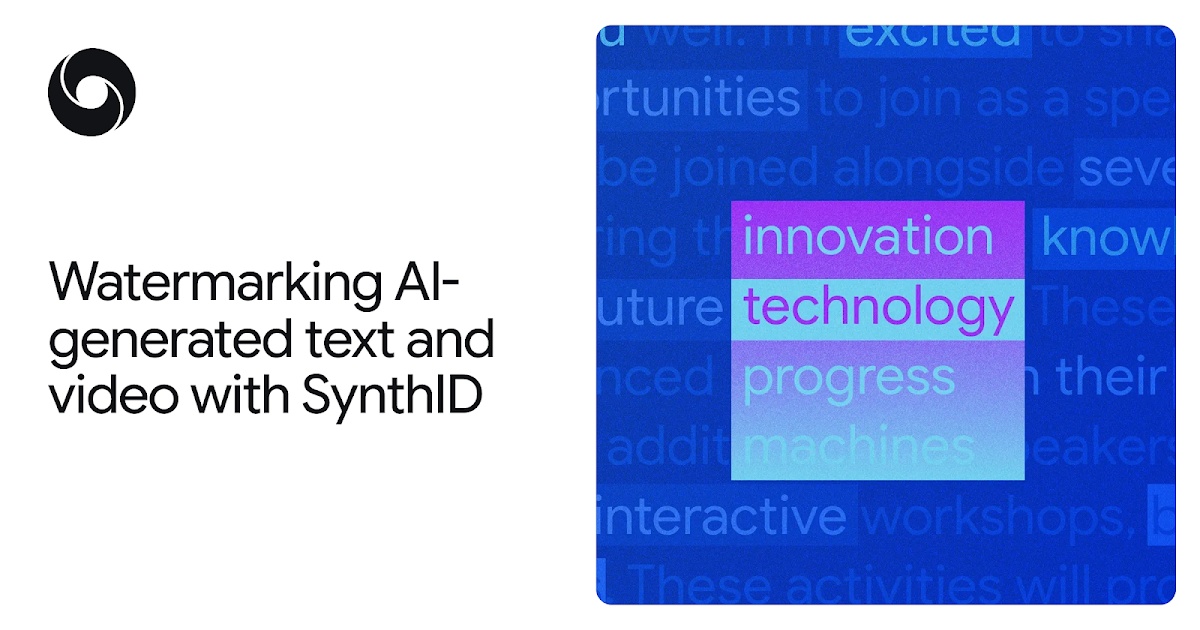
For text, it's a little different, but just as clever. Think of how AI language models (like the ones that write text) work: they guess the next word or part of a word. SynthID for text works by subtly changing the chances of certain words being picked. It adds tiny, invisible bits of information into the text as it's being written. Specifically, it functions as a logits processor, augmenting the model's logits using a pseudorandom g-function to encode watermarking information after Top-K and Top-P sampling, as explained by Google DeepMind. And here's what's really important: it does all this without making the text any worse in quality, accuracy, creativity, or speed (DeepMind Blog).
If you're a developer who likes to dig into code, the open-source text watermarking tool gives you a peek at how it all works. Here's a quick example of how you might set up a model to use SynthID for text:
# Initialize a standard tokenizer from Transformers.\ntokenizer = transformers.AutoTokenizer.from_pretrained(MODEL_NAME)\n# Initialize a SynthID Text-enabled model.\nmodel = synthid_mixin.SynthIDGemmaForCausalLM.from_pretrained(\nMODEL_NAME,\ndevice_map='auto',\ntorch_dtype=torch.bfloat16,\n)\n# Prepare your inputs in the usual way.\ninputs = tokenizer(\nINPUTS,\nreturn_tensors='pt',\npadding=True,\n).to(DEVICE)\n# Generate watermarked text.\noutputs = model.generate(\n**inputs,\ndo_sample=True,\nmax_length=1024,\ntemperature=TEMPERATURE,\ntop_k=TOP_K,\ntop_p=TOP_P,\n)\n
This example code, which you can find on GitHub (Google DeepMind GitHub), builds on top of other popular AI tools. It lets you create text with watermarks and then check for them using different methods.
The sheer amount of content SynthID is already used on is pretty amazing: SynthID for images has put watermarks on more than ten billion pictures and video frames across all of Google's different services (SynthID-Image Paper).
#Create and activate the virtual environmentpython3 -m venv~/.venvs/synthidsource~/.venvs/synthid/bin/activate#Download and install SynthID Text and Jupytergit clone https://github.com/google-deepmind/synthid-text.gitcdsynthid-text\npip install'.[notebook-local]'#Start the Jupyter serverpython -m notebook
How SynthID Works in Google's Own Products
Google isn't just saying SynthID is good; they're actually using it in their own products. They've put SynthID text watermarking into the Gemini app and on the web. And get this: their own tests show really good results! Researchers found that SynthID text didn't make the AI's writing worse or change how good or helpful it was, even after looking at almost 20 million responses from Gemini (DeepMind Blog). This is super important, because if a watermark made content look bad, no one would want to use it.
📸 Main Featured Image / OpenGraph Image
How Tough Is It? What SynthID Can Handle
One of the toughest things for any digital watermark is how 'robust' it is – meaning, how well it survives if someone tries to change it. SynthID for images is built to handle changes like cropping, adding filters, speeding up or slowing down videos, or making files smaller (DeepMind Blog). This is super important because AI-made content often gets shared, tweaked, and shared again on different websites, changing a lot along the way.
Right now, only a few trusted people can use the tool to check for SynthID watermarks in images. This means Google is carefully rolling it out to make sure it works well in the real world.
Very tough (handles cropping, filters, making files smaller) (DeepMind Blog)
Some limits (if text is translated, rewritten, or very short) (Researchers Note)
What People Are Really Saying About It
It's Not a Magic Fix: SynthID's Limits and Doubts
While SynthID's technology is really impressive, we need to talk about its downsides too. Even Google DeepMind admits that SynthID isn't a magic fix for spotting all AI-made content (DeepMind Blog). Lots of people in the tech world and many researchers agree with this.
From what I've looked into and heard from others, there are a few big limits. For text, especially, the watermarks might not work as well against really clever people trying to hide them. Experts also say these AI watermarks aren't perfect. They have trouble if text is translated, rewritten, or if it's very short and just stating facts (Researchers Note). So, if someone takes AI-made text, changes it a lot, translates it back and forth, or uses it for just a few simple sentences, the watermark could disappear or become impossible to find.
Another big challenge is getting everyone to use it. For SynthID to really work well, it needs to be built into tons of different websites and AI tools, not just Google's. This means many companies need to work together, which is a really hard thing to do.
📸 Main Featured Image / OpenGraph Image
More Than Just Watermarks: Tracing Where AI Content Comes From
It's important to see SynthID as just one part of a much bigger picture. Fighting against fake news made by AI isn't only about watermarks. It's about having a full plan to track where digital content comes from and its history. Groups like C2PA (which stands for Coalition for Content Provenance and Authenticity) are trying to set new rules for how clear and real AI content should be. Big players like Google and other tech companies are part of this. This focus on being open and real reminds me of what we talked about before with Google DeepMind's work on AI music, especially with Lyria 3 and making AI music ethically.
These efforts want to build a stronger system for checking if content is real. They often use special digital codes and hidden info that's hard to remove or change. SynthID fits into this whole picture as a basic tool, giving us a first way to identify AI content right when it's made.
📸 Main Featured Image / OpenGraph Image
My Final Verdict: Should You Use It?
What Does This Mean for You? Navigating AI Content Authenticity
So, what do I really think? Google DeepMind's SynthID is definitely a big and strong step forward in spotting AI-made content in all its forms. The fact that it now works for text and video, especially with the text watermarking becoming open-source soon, is a huge deal for developers and creators who want to make AI tools more trustworthy.
But here's the thing: it's super important to know that SynthID is just a basic piece of the puzzle, not the whole answer. It's a strong tool for you to use, but it won't fix all the tough problems of fake information and clever misuse by itself. If you're a hobbyist, a content creator, or a developer, using tools like SynthID helps make the digital world more open and honest. But always remember to think critically about any content you see, even if it has a watermark.
If you're hoping for a magic solution, you won't find it here. But if you want a strong, well-made tool that really helps us spot AI-made content, especially within Google's world and soon in your own projects, then SynthID is definitely something to keep an eye on. It's a key part of a bigger plan to prove content is real, and making its text tool open-source will spark lots of new ideas in this important field.
📸 Main Featured Image / OpenGraph Image
Frequently Asked Questions
Can SynthID stop all fake AI content?
No, Google DeepMind clearly says SynthID isn't a "magic fix." While it's a strong tool for finding AI-made content, especially in Google's own apps, it has limits. For example, it might not work if someone heavily rewrites, translates, or uses very short pieces of text. It's just one important part of a bigger plan to make sure content is real.
Will SynthID make my AI-made text worse or less creative?
Google's own tests, which looked at almost 20 million Gemini responses, showed that SynthID text watermarking didn't make the AI-made text worse in quality, accuracy, creativity, or speed. The watermark is designed to be invisible and won't make the text less helpful.
Should I only trust SynthID to tell if content is real?
No, SynthID is just a basic piece of the puzzle, not the whole answer. It's super important to use your own critical thinking and also look at other efforts, like those from groups such as C2PA. These groups are working to create a bigger system for checking where content comes from and its history.
Specializing in enterprise AI implementation and ROI analysis. With over 5 years of experience in deploying conversational AI, Yousef provides hands-on insights into what works in the real world.