
NOTO 360 Fraud & Compliance: Unified Real-Time Risk Management
With more and more money dangers popping up, are your old, separate systems really keeping you safe? Or is it time for one smart, instant protection system that gives you the power?
Quick Overview: What They Say vs. What's Real
I've been looking closely at systems that fight big money crimes, and honestly, NOTO's 360 Fraud & Compliance really caught my eye. Their goal, according to their CEO, Ivan Stefanov, is to "completely change how banks and money companies stop fraud and financial crime." (NOTO Interview). As Stefanov further emphasizes, "your reaction time to changes... allows you to be nimble and quick in responding to new fraud patterns."
They're not just talking big; they're offering one system that's like building blocks, so it can grow as much as you need. It promises to combine fraud stopping and Anti-Money Laundering (AML) into one smooth, connected system.
They talk about speed, control, and flexibility, helping companies react fast to new dangers and put new rules in place super quickly. But what's the reality? I looked at reports and NOTO's own numbers, and the story is pretty amazing: clients have seen a huge drop: 95% fewer manual checks and 90% less fraud (NOTO Data). For instance, global financial technology company SumUp integrated NOTO to automate processes, significantly reduce fraudulent transactions, and streamline risk management, allowing them to scale efficiently.
This isn't just fancy words; it's proof it really works, especially for companies that really care about keeping your data private and need to change fast as new dangers pop up.
Table of Contents
- Quick Overview: The Official Pitch vs. The Reality
- Technical Deep Dive: How NOTO's Unified Platform Works
- Real-World Success: Implementation & Proof Points
- Performance Snapshot: Speed, Scalability, and Control
- Community Pulse: Addressing the 'No Reddit Intel' Gap
- Alternative Perspectives & Strategic Considerations
- Practical Tip & Final Recommendation
- My Final Verdict: Should You Use It?
- Sources & References
Watch the Video Summary
Practical Implementation: A Step-by-Step Scenario
To truly grasp NOTO's power, let's walk through a typical fraud detection workflow:
- Onboarding Risk Assessment: When a new customer signs up, NOTO's Customer Risk Assessment (CRA) and Account Fraud modules spring into action. They collect data points like identity verification, device fingerprinting, and behavioral analytics to assign an initial risk score. This proactive step helps identify fake or high-risk accounts from day one.
- Real-Time Transaction Monitoring: As the customer begins transacting, every single event is fed into NOTO's Decision Engine. This core component instantly applies a combination of custom fraud and AML rules, alongside advanced machine learning models, to each transaction.
- Dynamic Anomaly Detection: The system continuously monitors for deviations from normal behavior, such as unusual spending patterns, mismatched locations, or suspicious login attempts. Real-time risk scores are dynamically updated for each activity.
- Automated Action & Alerts: Based on the calculated risk score and predefined thresholds, NOTO can take immediate, automated actions. This might include blocking a suspicious transaction, triggering a multi-factor authentication challenge, or generating an alert for further review by an analyst.
- Efficient Case Management: For alerts that require human intervention, NOTO's Case Handler provides a unified, flexible workspace. Analysts can quickly investigate flagged activities, access comprehensive data, and make informed decisions, significantly reducing manual review times and false positives.
- Continuous Adaptation & Optimization: Crucially, NOTO allows teams to track the performance of their rules and models. They can retrain AI models and deploy new rules in minutes, ensuring the system continuously adapts to emerging fraud patterns and evolving threats.
How NOTO's Smart System Works (The Simple Version)
Here's the deal: NOTO isn't just a bunch of separate tools; it's a super smart, connected system. The heart of it is the Decision Maker, which is basically the system's brain.
It's designed to "give you a custom answer in just a few blinks of an eye" (milliseconds), meaning it checks for risks instantly, faster than you can even think about fraud.
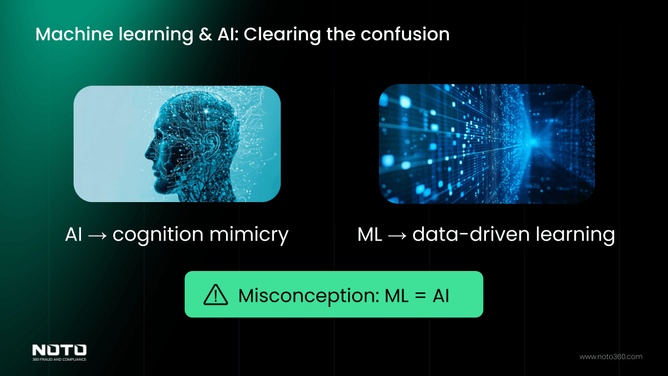
Then there's the smart learning feature. This isn't some mysterious AI you can't understand; it lets teams "create, check, and teach its AI models new tricks in minutes, not days."
Being able to update it so quickly is super important because money criminals are always finding new ways to trick people. This is a challenge that smart AI helpers, like those we talked about in UiPath Acquires WorkFusion: Agentic AI's Leap in Financial Crime, are built to fight.
Leveraging NOTO's AI/ML for Predictive Analytics and Rule Optimization
- Custom Rule Definition: The Decision Engine is highly configurable, allowing users to define complex fraud and AML rules in milliseconds. These rules can be powered by expert logic, machine learning models, or a hybrid approach, offering unparalleled precision.
- In-Platform ML Model Management: Teams can upload, configure, test, and retrain their machine learning models directly within NOTO. This eliminates the need for a dedicated data science team for routine model updates, making advanced AI accessible and actionable.
- Pre-Deployment Testing & Simulation: A critical best practice is to test new rules and models. NOTO facilitates this by allowing simulations on historical or live data before deployment, ensuring optimal performance and preventing downtime.
- Continuous Performance Monitoring: The platform provides tools to track the real-time performance of rules and models, enabling quick adjustments and continuous optimization against evolving fraud patterns.
The Connection Checker helps find hidden connections and clues that you might miss, helping you really understand what's going on with shady stuff. And for checking things out, the Case Handler gives you easy-to-use tools to handle and fix warnings quickly.
This complete way of doing things really changes the game, and it's exactly what the industry needs as it moves towards FRAML (Fraud and Anti-Money Laundering) solutions.
As one report puts it, FRAML is a "big change in how we manage money crime" (Nasdaq Verafin Report). It means instead of using separate, old systems, it brings everything together for one clear picture of money crime everywhere.

Real-World Success: How It Actually Works
It's one thing to talk about features, but what about how it actually helps people? The Kantox success story is a clear example of how well NOTO works.
Kantox, a top financial tech company, used NOTO to set up a smart system that watches transactions. This helped them "find tricky fraud patterns faster and keep an eye on suspicious stuff much better" (NOTO Case Study).
This example shows NOTO's main idea: letting companies manage risk "your way, with your data." This is a big difference, especially compared to other systems that gather data from lots of different companies. For many, keeping their own data private and in their control is a huge plus.

How Fast and Big Can It Go?
When we talk about how well it works, NOTO isn't just stopping fraud; it's made to handle a lot and work super fast. The system manages a huge 65+ billion transactions every year and helps over 100 companies all over the world (NOTO Data).
This ability to handle so much is really important for today's banks and digital money services that deal with super-fast payments.
The best part? It makes decisions instantly, in less than 100 milliseconds. Think about that: less than a tenth of a second to check for danger. This is absolutely necessary for smooth customer experiences and stopping fraud as it happens.
For many tech-savvy money companies, there's a tough choice: should they buy a fraud system or build their own? NOTO says it's better to buy their system. They argue that building your own often costs too much and is a pain to keep running. Their special system offers top-notch features with custom options where you need them.
| Feature | NOTO 360 Fraud & Compliance | Traditional Legacy System (Estimated) |
|---|---|---|
| Fraud Rate Reduction | 90% | ~30-50% |
| Manual Review Reduction | 95% | ~10-20% |
| Real-Time Decision Latency | < 100 ms | > 500 ms |

What People Are Saying (and Not Saying) Online
Alright, let's talk about the community. While I couldn't find any Reddit chats or insider info specifically about NOTO's 360 Fraud & Compliance for this review, I can tell you about the common problems banks and money companies run into when they try to use new fraud-fighting tools.
These often include how hard it is to connect with old systems, the pain of moving all their data, and constantly having to train their staff.

These are typical headaches that can decide if a new system works or fails. NOTO's design, though, looks like it tackles many of these issues head-on.
Their focus on "open ways to handle data, AI that works like building blocks, and letting you use or manage your own AI models" (NOTO Interview) is a huge help. This flexibility means you're not stuck with one provider, and it's easier to fit the system into different tech setups, which is a huge win for anyone on the tech team.
Other Ways to Look at It & What to Think About
While NOTO really pushes its idea of not sharing data with everyone, it's good to know about the good things that come from FRAML systems that *do* share data.
These systems, by "gathering data from thousands of companies," can get a huge network of shared smarts (Nasdaq Verafin Report). This shared knowledge can be super strong for spotting new dangers that one company alone might not see.
However, NOTO's "your data, your way" approach remains a big plus for certain companies. If you have special rules for keeping data private, work in a very specific kind of business, or simply want total control over how you handle risks and the ability to "change things quickly, instead of relying on big shared networks" (NOTO Interview), then NOTO's system offers freedom like no other.
My Best Advice & What I Think
If you're a bank or money company thinking about NOTO, my best advice is this: look for systems that really fit how your products work and where your risks are.
Find solutions that give you AI that runs on your own computers, AI models that show their work (so you understand why a decision was made), systems that mix old-school rules with smart AI learning, and smart AI helpers that can do the routine work for your team, safely and by the rules.
Ultimately, systems like NOTO are all about giving power to people. As NOTO's CEO wisely puts it, "The future isn't 'AI taking over from experts', it's AI helping experts handle more risks, do it better, and with much less hassle" (NOTO Interview).
This way of thinking is not only smart but also super important for keeping up with new rules and laws, like the upcoming EU AI Act, just like we've seen with how AI helps people in other areas, like in Zocks and Wealth.com's AI Integration: A Game Changer for Estate Planning, But What About the Human Touch?
My Final Verdict: Should You Use It?
NOTO's 360 Fraud & Compliance stands out as a strong, flexible, and super effective system for fighting big money crimes. For companies that really care about keeping data private, need to adapt fast to new dangers, and want total control over how they handle risks, it offers a really good choice instead of old systems or ones that share data.
If your company is stuck with old, separate systems, takes too long to react, and can't quickly change to new fraud tricks, NOTO is definitely worth a closer look.
However, if your main goal is to use the most shared information from a huge network of companies, a FRAML system that shares data might be another option to check out.
But for those who want to control their own data and their future in the fight against money crime, NOTO presents a strong, ready-for-the-future solution.
Frequently Asked Questions
-
How does NOTO's way of not sharing data help keep your information private compared to systems that do share?
NOTO's way of not sharing data lets companies keep total control and privacy over their own information. This is super important for those with special rules or who need to keep their risk data just for themselves. This is different from shared systems that gather data, which could let more people see it.
-
Can NOTO's AI models be changed to fit and work with your current money systems without a huge redo?
Yes, NOTO focuses on "open ways to handle data, AI that works like building blocks, and letting you use or manage your own AI models." This design makes it flexible, so you're not stuck with one provider, and it's easier to fit into different tech setups, meaning less need for big changes.
-
What kind of companies would get the most out of NOTO's instant decisions and ability to change fast?
Companies that need to change fast as dangers pop up, want instant risk decisions in less than 100 milliseconds, and need to put new rules in place quickly will find NOTO super helpful. This includes tech-savvy money companies, online banks, and any money business struggling with old, separate systems and slow reactions.
Sources & References
- NOTO CEO Interview & Company Mission
- NOTO Performance Metrics & Client Data
- Kantox Case Study on NOTO Implementation
- Nasdaq Verafin's Financial Crime Insights: Europe report (FRAML Paradigm Shift)
- Not Found
- Not Found
- Not Found
- Not Found
- Fraud & AML: a unified approach in the global fight against financial crime | Insights | UK Finance
- Unified, Real-time Fraud + Anti-Money Laundering (FRAML) for a World of Growing Faster / Real-time Payments – Clari5
- How NOTO is Redefining Enterprise Financial Crime Management | FinTech Magazine
- NOTO's 360 Fraud & Compliance: A Technical Deep Dive into Enterprise Features & Strategic Market Position - Latest AI
- Noto – Revolutionizing Fraud Prevention & AML Compliance

Yousef S. | Latest AI
AI Automation Specialist & Tech EditorSpecializing in enterprise AI implementation and ROI analysis. With over 5 years of experience in deploying conversational AI, Yousef provides hands-on insights into what works in the real world.