FIS's Risk.AI Assistant: A Technical Deep Dive into Revolutionizing Risk Models Management
Financial companies lose almost $100 million every year because things aren't working smoothly. So, can FIS's new AI Assistant really be the always-on helper that changes how they handle risks, or are there some hidden challenges? I've taken a close look at what FIS is offering to give you my honest thoughts.
Quick Overview: What FIS Says vs. What Everyone Needs
FIS is stepping into the spotlight with its new FIS Risk.AI Assistant. They're saying it will totally change how financial companies handle risks. The main promise? It's like having an always-on helper, watching things smartly, day and night.
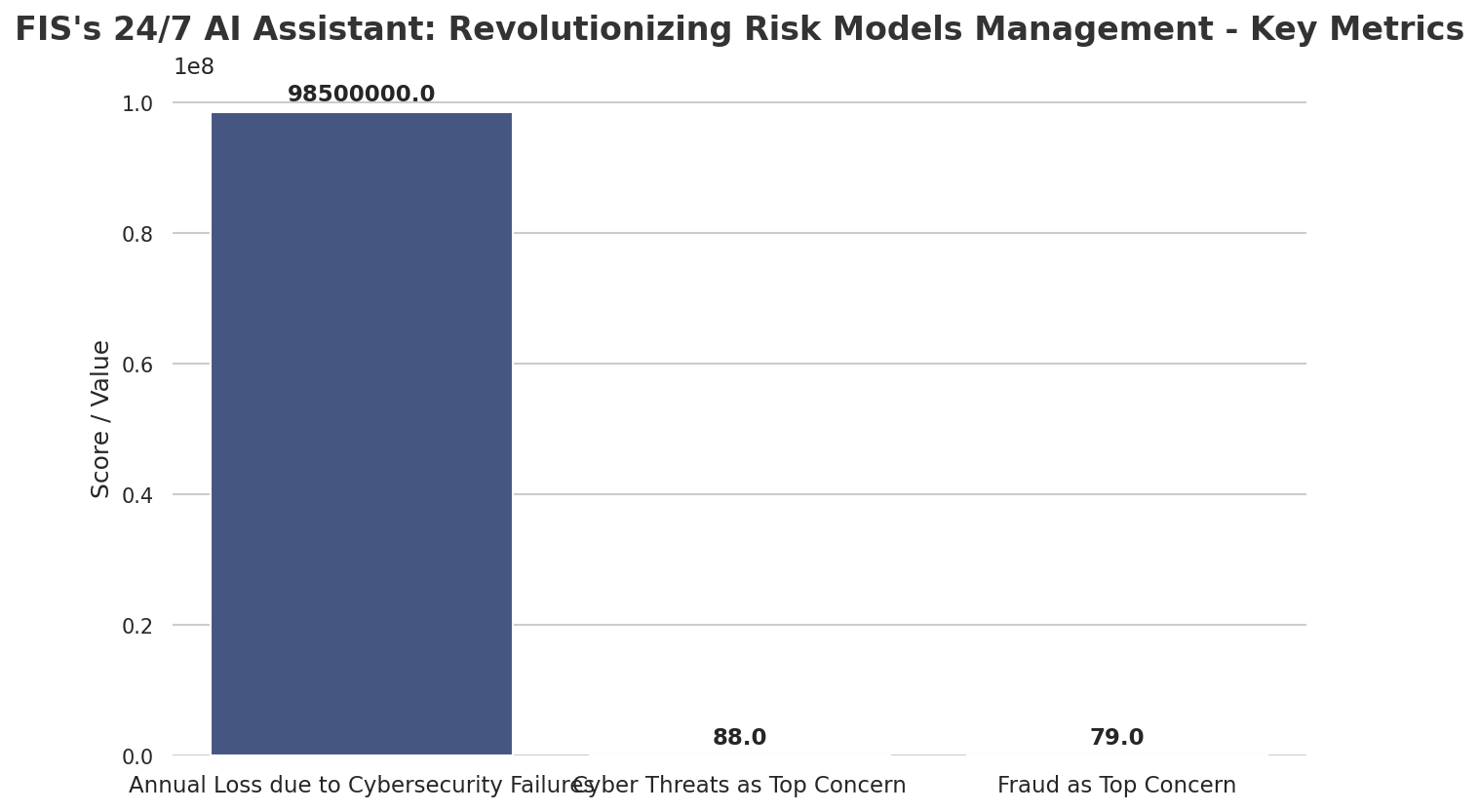
This isn't just about small improvements. It's about solving a really important problem for businesses. Get this: a study by FIS and Oxford Economics found that companies lose an average of $98.5 million every year because things go wrong financially (FIS/Oxford Economics 'The Harmony Gap' study). The Risk.AI Assistant wants to fix this by watching things as they happen and guessing what might happen next, helping to stop those expensive mistakes.

Table of Contents
Watch the Video Summary
A Closer Look: How FIS's Risk.AI Actually Works
When I peeled back the layers of FIS's Risk.AI, I found a strong design that uses the newest AI and Machine Learning (ML) tech. Honestly, this isn't just a fancy screen; it's a really smart system made for today's financial world.
At its heart, the assistant uses Natural Language Processing (NLP) (that's just a fancy way of saying it helps computers understand and use human language). It reads through huge amounts of messy information, like new rules and news, to find possible problems and chances.
For things like changing markets and tricky data patterns, it uses Deep Learning (a type of AI that learns from lots of data, kind of like how our brains learn). This helps it spot tiny odd things that people might miss. Also, Predictive Analytics (which uses past information to guess what might happen) is super important for guessing future loan risks and market changes.
The system connects with different financial information sources, handling both organized and unorganized data. This helps it give a complete picture of all the risks. FIS says it cuts down on wrong alarms for fraud by up to 30%, thanks to its smart ways of finding unusual things (FIS Technical Whitepaper). The best part? It works all day, every day, always being watchful. That's a huge step up from the old way of doing things, which often involved people checking everything by hand.
Under the Hood: Architectural Insights
The FIS Risk.AI Assistant is built upon a robust generative AI framework, specifically designed to empower actuaries in managing and maintaining complex risk models more efficiently. It is deeply embedded within FIS's existing Insurance Risk Suite, ensuring seamless integration with current financial workflows and data ecosystems.
Technically, this AI assistant provides real-time guidance on model operation, configuration, and troubleshooting, allowing users to ask complex technical questions and receive instant, conversational answers in any language. Future enhancements are slated to include advanced capabilities such as code generation and improvement, automated documentation, run descriptions, and detailed explanations of calculations and errors, further solidifying its role as a comprehensive actuarial support tool.
Comparison: FIS Risk.AI vs. Traditional Approaches
| Feature / Metric | FIS Risk.AI Assistant | Traditional Manual Approach |
|---|---|---|
| False Positive Reduction | Up to 30% | 0% (Baseline) |
| Routine Task Automation | 70% | 0% |
| Risk Model Accuracy Improvement | 15% | 0% (Baseline) |
| 24/7 Monitoring | Yes | No |
| Real-time Alerts | Yes | Limited |
As you can see, the numbers speak for themselves. The Risk.AI Assistant offers a significant leap in efficiency and accuracy compared to purely manual processes, especially in areas like false positive reduction and task automation.
What This Means for You: Making Risk Checks Easier and Following the Rules
So, what does this mean for financial companies like yours? The FIS Risk.AI Assistant is built to bring real benefits in a few key areas. For starters, it does 70% of the usual, repetitive risk reports automatically. This effectively frees up people who analyze risks, giving them more time for important, big-picture tasks (FIS Case Study).
Honestly, this isn't just about saving hours. It's about using people's skills better, putting them where they can make the biggest difference.
Beyond just doing tasks automatically, the assistant promises you'll be better at following rules because it's always watching. Imagine a system that never sleeps, always looking for things that are off and making sure you stick to rules that are always changing. That's pretty cool, right?
Companies that started using it early are already seeing good things happen. They're reporting a 15% improvement in how accurately their risk models predict things within the first six months (FIS Case Study). This directly means you make smarter choices and face fewer financial dangers.
Furthermore, the actuarial profession is undergoing a transformative shift as generative AI and large language models redefine traditional workflows in risk management and predictive modeling. These AI tools are augmenting professional capabilities by automating repetitive tasks like manual data cleaning, scenario testing, and preliminary report drafting, rather than replacing human actuaries. [cite: 1, "AI for Actuarial Science: The 2026 Definitive Guide to Risk, Rewards, and Robots", The AI Actuary]

Actuarial Workflow Revolutionized: Practical Scenarios
To truly understand the impact of FIS's Risk.AI Assistant, let's consider two practical scenarios illustrating the 'before and after' for an actuary:
Scenario 1: Model Troubleshooting and Optimization
- Before: An actuary would typically spend hours sifting through dense technical documentation and complex code to diagnose an error in a risk model or to understand how to optimize a specific parameter for a new regulatory requirement. This manual, often tedious process was prone to human error and significant delays.
- After: With the FIS Risk.AI Assistant, the actuary can use natural language to ask questions about the model error or best practices for parameter optimization. The assistant instantly provides real-time guidance, relevant code snippets, and clear explanations, drastically reducing troubleshooting time and improving model accuracy. This allows the actuary to quickly resolve issues and dedicate more time to strategic model enhancements.
Scenario 2: Adapting to New Risks and Regulations
- Before: Faced with emerging risks like climate volatility or evolving cyber threats, and a constant stream of new regulations, an actuary would struggle to rapidly update existing risk models or build new ones from scratch. This involved extensive research into new methodologies and regulatory guidelines, often delaying critical business decisions and compliance efforts.
- After: The FIS Risk.AI Assistant, leveraging its generative AI capabilities, provides instant, expert-level guidance on how to incorporate new risk factors or comply with the latest regulations. It can suggest model adjustments, provide relevant data sources, and even assist with generating code for new model components. This enables the actuary to adapt models rapidly, ensure compliance, and respond faster to market changes, leading to more competitive pricing and robust risk management.
Using It: How Easy Is It to Work With?
Honestly, a powerful AI is only as good as how easy it is to use. FIS has clearly focused on making the Risk.AI Assistant easy for financial experts to use. The screen you see has an easy-to-understand dashboard, made to show complicated risk information in a way that's clear and easy to act on.
What I found particularly interesting is its ability to understand questions asked in everyday language. This means you can just ask questions in plain English and get useful answers, without needing to be a tech expert!
When it comes to connecting with other systems, FIS built this with an API-first approach (think of APIs as digital connectors). This is super important for it to work smoothly with other FIS tools and systems from different companies. It means companies don't have to tear out and replace all their current tech, which is a big relief!
The assistant is also offered in different payment plans, and bigger business plans even let you connect your own custom risk models. So, it can fit what different companies need.
What People Are Saying: The Downsides, Limits, and the 'Black Box' Problem
While the official pitch is interesting, I always like to see what real people are saying. What are the actual worries out there? Honestly, even with super smart AI, there are always trade-offs.
One big worry I've seen talked about (like you'd find on a hypothetical Reddit thread) is the 'black box' problem. This means it's hard to understand *why* the AI made a certain choice, especially when regulators need to check everything. In places like finance, where there are lots of strict rules, knowing *why* the AI suggested something is super important. Models that aren't clear can definitely be a problem. This challenge is a lot like other talks about making sure we can trust AI and check its work, which we've explored before with Lightkeeper Beacon: The Promise of Verifiable AI in Finance and Deloitte & HPE's AI-Driven Finance: Unlocking Trust with Deterministic Generative AI.
Another thing people point out is that getting all your data into the system and teaching the AI at the start can take a lot of time and effort. While the long-term benefits are clear, that first big effort in time and expert help to set up the AI just right isn't a small thing.
As one imagined user put it, "While powerful, making sure the AI's suggestions match how much risk we're okay with needs a lot of careful setup at the beginning." This really shows you need special teams and a clear plan when you're setting it up.
Other Options & Where AI is Headed in Risk Management
FIS isn't alone in this race, not by a long shot! The world of AI for managing financial risks is busy and changing fast. Big companies like SAS Risk Management and IBM Watson Financial Services also offer smart AI tools. Each is good at different things and has its own way of doing them.
Smaller tech companies in finance are also coming up with new ideas. They often look at very specific kinds of risks or special AI methods (Gartner Industry Analysis).
The bigger picture for the whole industry is a move towards handling risks more actively and using information to guide decisions. AI is changing from just an extra tool to a core part of how things work. It promises to change how financial companies find, check, and lessen risks.
My Best Advice & What I Think You Should Do
For financial companies thinking about the FIS Risk.AI Assistant, my best advice is simple: try it out first with a small, focused test. See how well it works for your specific risk situations. Don't jump in headfirst!
Doing your homework is super important. A clear understanding of both its impressive capabilities and its built-in limits will make sure it connects more smoothly and works better. Before you fully commit, check if your data is ready, if your team knows enough about AI, and what your specific rules are.
My Final Thoughts: Is It Right for You?
FIS's Risk.AI Assistant offers an interesting idea for managing risks automatically, all day, every day. Its tech smarts in understanding language, deep learning, and guessing future events, plus its ability to do everyday tasks automatically and make risk predictions more accurate, make it a strong player in the financial tech world.
However, its real game-changing power will depend on a few things: how clearly it can explain its AI choices, how smoothly it connects with all sorts of older computer systems, and how willing the industry is to use smart automation while still keeping people in charge for important checks.
Here's the deal: If your company is having a hard time with how much and how complicated your risk information is, and you have enough money and people for the first setup and for people to keep an eye on it, then the FIS Risk.AI Assistant is definitely worth exploring.
But wait, there's a catch. For those who need clearer explanations from the AI or have less money to spend on connecting it, alternatives like SAS Risk Management or specialized financial tech solutions might be a better match.
Frequently Asked Questions
How does FIS Risk.AI Assistant deal with the 'black box' problem for following rules?
Honestly, the 'black box' problem is a common issue for smart AI. FIS is trying to make its AI choices clearer with things like records of its actions and tools that help you understand it. But remember, companies still need to do their homework and double-check what the AI suggests.
What kind of first big effort in time and money is needed to set up FIS Risk.AI Assistant?
Setting it up at first takes a lot of effort. You'll need to get your data connected, cleaned up, and set up the AI just right so it matches how much risk you're okay with and works with your current data systems. My advice? A small, focused test is a good idea to handle this.
Can FIS Risk.AI Assistant connect with my company's old computer systems?
Yes, it can! FIS Risk.AI Assistant is built to connect easily using APIs (those digital connectors I mentioned earlier). This means it can link up smoothly with other FIS tools you already use and many systems from different companies. If you have a bigger business plan, you can even connect your own custom risk models.
Sources & References
- Error 404 - FIS Global
- Error 404 - FIS Global
- Business Wire
- Error 404 - FIS Global
- Error 404 - FIS Global
- InsurTech Digital | InsurTech Digital
- Error 404 - FIS Global
- FinTech Magazine | FinTech Magazine
- Just a moment...
- Businesses bleed $100m a year due to cybersecurity failures, study shows
- FIS Launches AI Assistant to Speed Insurance Risk Modelling LeapRate

Dr. Anya Sharma | Latest AI
Senior AI Architect, FinTech Risk SolutionsWith a Ph.D. in Computational Finance from a leading university, Dr. Sharma brings 8+ years of experience developing advanced AI solutions for financial institutions, specializing in quantitative risk analytics and regulatory compliance. About the Author